Most mornings, I wake up already owing something to the day.
To my children. To the farm. To the animals.
And only later — if there’s anything left — to myself.
My alarm goes off before my body is ready to move.
Sometimes it’s still dark. Sometimes it’s already too hot.
Either way, there’s no softness in the beginning of the day.
I move quietly through the house, half-awake, half-alert.
Lunchboxes. School clothes. A missing sock.
A child who doesn’t want to get up.
Another who needs to be held a little longer before I can let go.
That pause — those extra seconds — is where motherhood lives.
Between responsibility and guilt.
Between “I have to go” and “stay just a little more.”
By the time the older girls leave for school, my coffee is still untouched.
I drink it standing, in small sips, already thinking ahead —
about the lambs that need feeding, the milk that can’t wait,
the work that doesn’t care how tired I am.
There’s a constant mental noise that never really turns off.
Lists running in my head.
What’s urgent. What can’t be delayed.
What I forgot yesterday and must fix today.
And somewhere between all of that, I become a farmer’s wife —
a role no one really explains to you.
It comes with clothes that never stay clean for long.
With smells that don’t wash out easily — hay, animals, milk, sweat.
With laundry every single day, because I still want my children
to smell fresh, clean, safe.
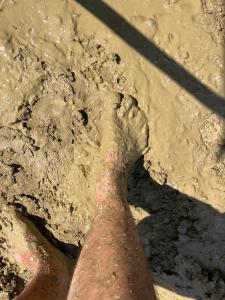
It means scrubbing boots, wiping mud from floors,
washing jackets that were clean just yesterday.
It means learning how to make a home feel soft
inside a life that is anything but.
But it also gives.
It gives fresh milk — still warm.
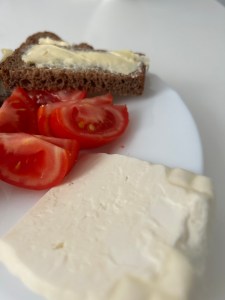
Cheese made by our own hands, the old way, with patience and time.
Eggs collected that morning.
Food that isn’t perfect, but is real.
There’s a strange contrast in that.
Your hands are tired, cracked, sometimes sore —
but what you place on the table is honest.
After breakfast, the real work begins.
Feeding animals. Checking water.
Cleaning spaces that will be dirty again by evening.
Helping lambs that are too weak to stand,
guiding them to their mothers, holding bottles, waiting, watching.
Time doesn’t move normally here.
Hours stretch. Tasks overlap.
You’re always needed somewhere else
while you’re still standing right where you are.
And yet, the day keeps asking for more.
By afternoon, exhaustion settles in quietly.
Not dramatically — just enough to remind you
that this life doesn’t pause for recovery.
You keep going.
Because stopping isn’t built into the system.
Evenings don’t bring silence the way people imagine.
They bring another round of care.
Another check. Another feeding. Another clean-up.
By the time the house finally slows down,
I realize I never really checked in with myself.
And this is what farm life takes.
It takes time.
It takes energy.
It takes the luxury of being tired and resting.
But this life also gives something harder to name.
It gives strength that isn’t loud.
Pride that doesn’t need applause.
A deep knowing that you can carry more than you thought possible.
It teaches my children where food comes from.
It teaches me where my limits are — and how often I cross them anyway.
I don’t romanticize this life anymore.
I respect it.
Because it asks for everything —
and then quietly teaches you who you are when you give it.
And still — this life doesn’t break me.
What saves me is knowing that, for me, the pluses are heavier than the minuses.
Not every day.
Not without doubt.
But enough to keep going.
Yes, it takes my time, my energy, my softness.
It takes the ease other women have.
It takes rest, comfort, and sometimes parts of my identity.
But it gives me something just as real.
It gives me food I trust.
Children who understand effort.
A home built on work, not appearances.
And a quiet confidence that I am capable — even on the days I feel empty.
I don’t stay because it’s easy.
I stay because, in the balance of all things,
this life gives me more than it takes.
And for now — that is enough for me.
 Farm Wife Unfiltered
Leave a comment